What to Do If Your Airline Shuts Down: Refunds, Chargebacks & Protecting Future Trips
Travel Advisor Guide
What to do if your airline shuts down — a complete, step-by-step plan for refunds, chargebacks, and rebooking, built around a real case study: the 2026 Spirit Airlines collapse.
When Spirit Airlines shut down overnight in May 2026 — the first major U.S. carrier collapse in 25 years — thousands of travelers learned in real time what to do (and what not to do) when an airline simply stops flying.
Airlines almost never announce their own collapse in advance. One day flights are operating normally; the next, a carrier grounds its entire fleet, closes its phone lines, and tells passengers not to come to the airport. If you have a ticket, loyalty points, a voucher, or a trip booked with an airline that just shut down, this guide walks through exactly what to do — how refunds actually work, when a credit card chargeback is your fastest path to your money, what travel insurance does and doesn’t cover, and how to protect every future purchase so this never leaves you stranded.
This guide is built around a real event: on May 2, 2026, Spirit Airlines ceased all operations overnight, becoming the first major U.S. airline to shut down since Midway Airlines in 2001. Roughly 60,000 passengers a day were affected in the weeks that followed, and Spirit’s exit removed a meaningful share of low-cost domestic capacity from the market. That situation is now resolved and its rescue fares and refund deadlines have long since expired — but the underlying playbook for what to do is exactly the same for any airline shutdown, past or future. Etravels Everywhere helps travelers rebook and recover whenever a supplier fails, and the steps below are the ones we actually use.
Why Airlines Shut Down With So Little Warning
The Pattern Behind Most Airline Collapses
Airline failures rarely come out of nowhere to people watching closely, even though they feel sudden to passengers. The typical pattern is a carrier operating on thin margins for years, one or more bankruptcy filings, a failed attempt to restructure debt or find new financing, and then a final trigger — a spike in fuel costs, a lost court ruling, a collapsed merger, or a lender pulling out — that removes the airline’s ability to keep flying. By the time a shutdown is announced, it is usually the end of a long financial decline rather than a single bad day.
Spirit Airlines followed this exact pattern. The carrier filed for bankruptcy twice — first in 2024, then again in August 2025 — and reached a reorganization deal with creditors in February 2026. Days later, a sharp spike in jet fuel prices tied to renewed conflict in the Middle East, combined with the collapse of talks over a proposed federal bailout, erased what cash cushion Spirit had left. On May 2, 2026, Spirit announced an “orderly wind-down of operations, effective immediately,” and its final flight landed overnight at Dallas-Fort Worth International Airport. Spirit is one example; discount carriers in other countries (Australia’s Bonza in 2024 and Iceland’s WOW air in 2019, among others) have collapsed the same way — healthy-looking one week, grounded the next.
Airline exits also affect travelers who weren’t flying that carrier. Analysis of aviation data by CBS News found that average fares on a route rise roughly 23% — about $60 per round trip — when a low-cost carrier like Spirit exits, as remaining airlines absorb the demand with less competitive pressure on price. That’s a reason to book important future travel with an advisor who can track fare movement, rather than waiting and hoping prices hold.
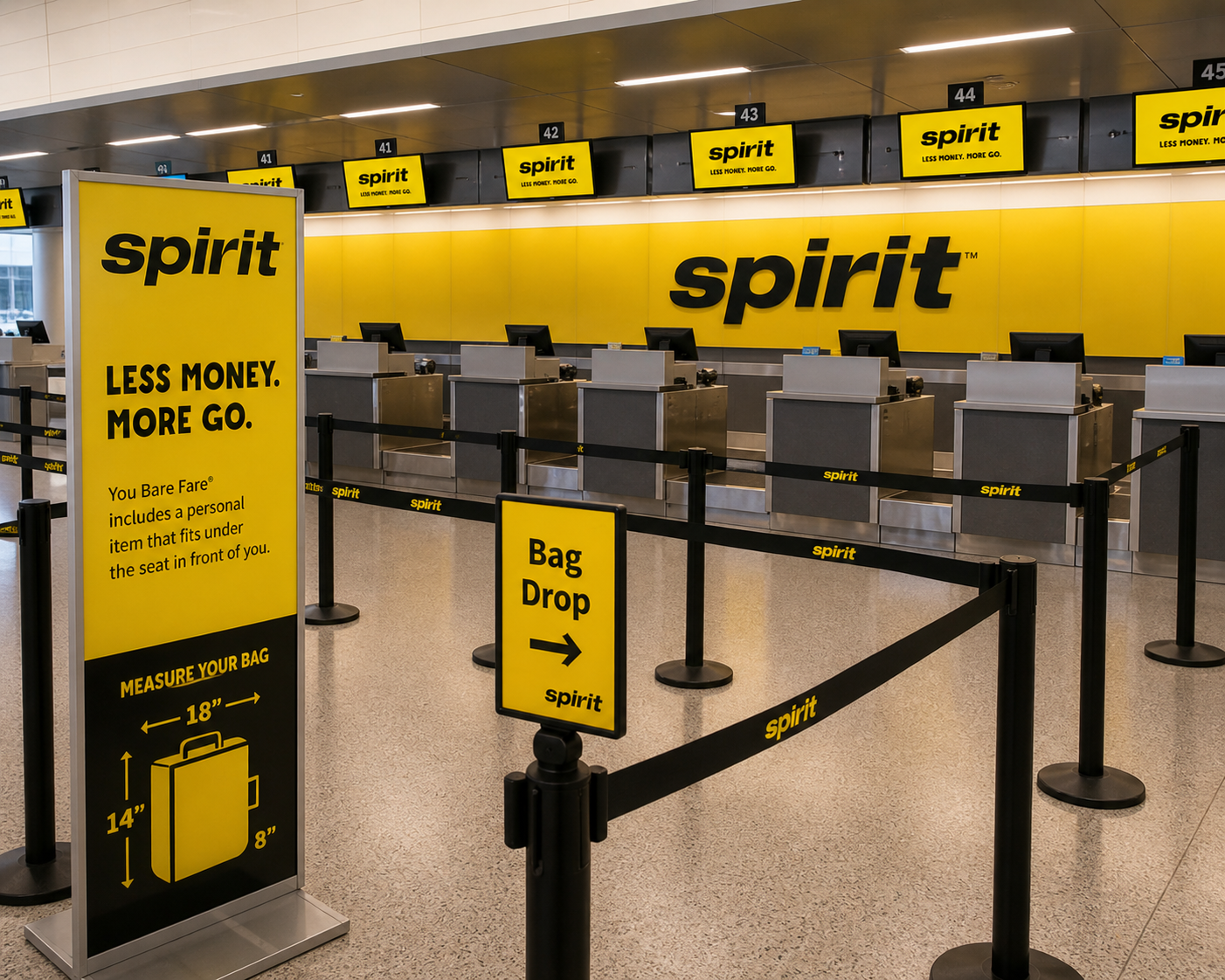
Spirit Airlines check-in counters sat empty across the country the morning of May 2, 2026, as passengers arrived to find the airline had shut down overnight with no notice.
What to Do Based on How You Booked
Your recovery path depends almost entirely on how you originally paid. Find your situation below and follow that path — the biggest mistake travelers make is calling the airline repeatedly instead of going straight to the option that actually applies to them.
You Booked Directly With a Credit Card
This is the strongest position to be in. Under U.S. Department of Transportation rules, airlines must issue a refund to your original payment method — not a travel credit, unless you agree to one — when a flight is cancelled and you don’t accept the replacement offered. In practice, a shut-down airline often can’t process refunds itself during a bankruptcy wind-down, so if nothing appears on your statement within a week or two, your fastest path is a credit card chargeback under the Fair Credit Billing Act. Call the number on the back of your card, tell the representative you’re disputing a charge for “services not rendered,” and provide your booking confirmation and the amount paid. Standard FCBA disputes must be filed within 60 days of the statement showing the charge, but many issuers extend that window to around 120 days from the date the service was supposed to be provided when the merchant is bankrupt — ask your issuer directly which applies.
You Booked Directly With a Debit Card
Debit cards don’t carry the same federal dispute protections as credit cards. You can still ask your bank to investigate the charge under its own dispute process, but outcomes are less predictable and banks are generally under less obligation to reverse the charge quickly. If you have a choice, always put airline tickets on a credit card rather than a debit card for exactly this reason — it’s the single easiest way to protect a future purchase.
You Booked Through a Third-Party Site (Expedia, Kayak, Priceline, etc.)
An airline generally won’t refund a ticket it never received your payment for directly — that money sits with the booking platform. Contact the third-party site’s customer service directly, and be ready to wait: call volume spikes hard after any airline collapse, so start there immediately rather than after trying the airline first. If the platform won’t refund you, you still have a credit card chargeback available against the platform’s charge, using the same “services not rendered” process above.
You Booked Through a Travel Advisor
This is the situation with the least stress. A travel advisor has direct relationships with airlines, consolidators, and insurance providers, and can usually push a refund or rebooking through channels that aren’t open to individual travelers calling in. If you booked through Etravels Everywhere, contact us directly rather than the airline — we handle the refund and rebooking process on your behalf.
You Have Loyalty Points or Miles With the Airline
This is the hardest category to recover. Loyalty points are typically treated as an unsecured claim against the airline in bankruptcy — meaning point holders are paid, if at all, only after secured creditors, and often at a small fraction of face value. If your airline enters bankruptcy, file a formal proof of claim through the bankruptcy court’s process as soon as it opens; some airline bankruptcies have produced partial recoveries for loyalty members through creditor settlements, though this is never guaranteed. If you ever paid a program fee (an annual card fee tied to the airline’s co-branded credit card, for example) with a credit card, that specific charge may separately be eligible for its own chargeback.
You Have Vouchers or Travel Credits
Vouchers and credits face the same uncertain fate as loyalty points in a bankruptcy — they’re an unsecured claim, not cash held in trust for you. Document everything immediately: screenshot the balance, save the original issuing email, and keep the receipt for whatever booking generated the credit. File that documentation as part of a bankruptcy claim. If the underlying purchase that produced the voucher was originally paid by credit card, ask your card issuer whether that original charge can still be disputed.
You Have Travel Insurance
Comprehensive travel insurance policies often include “financial default” or “supplier default” coverage, built specifically for situations where an airline, cruise line, tour operator, or hotel ceases operations. Two things determine whether it actually pays out. First, timing: most insurers require this specific coverage to be purchased within roughly 10 to 21 days of your first trip deposit, with a waiting period of 10 to 30 days before it takes effect — buying a policy after trouble is already in the news is usually too late. Second, “foreseeability”: if an airline’s financial distress was already widely reported before you bought your policy, insurers can treat the eventual shutdown as a foreseen event and deny the claim on that basis. If you’re covered, contact your provider immediately with your booking confirmation, proof of payment, and documentation of the shutdown — most policies have their own filing deadlines. Use our free Travel Insurance Checker to see what a policy actually covers before you buy one.
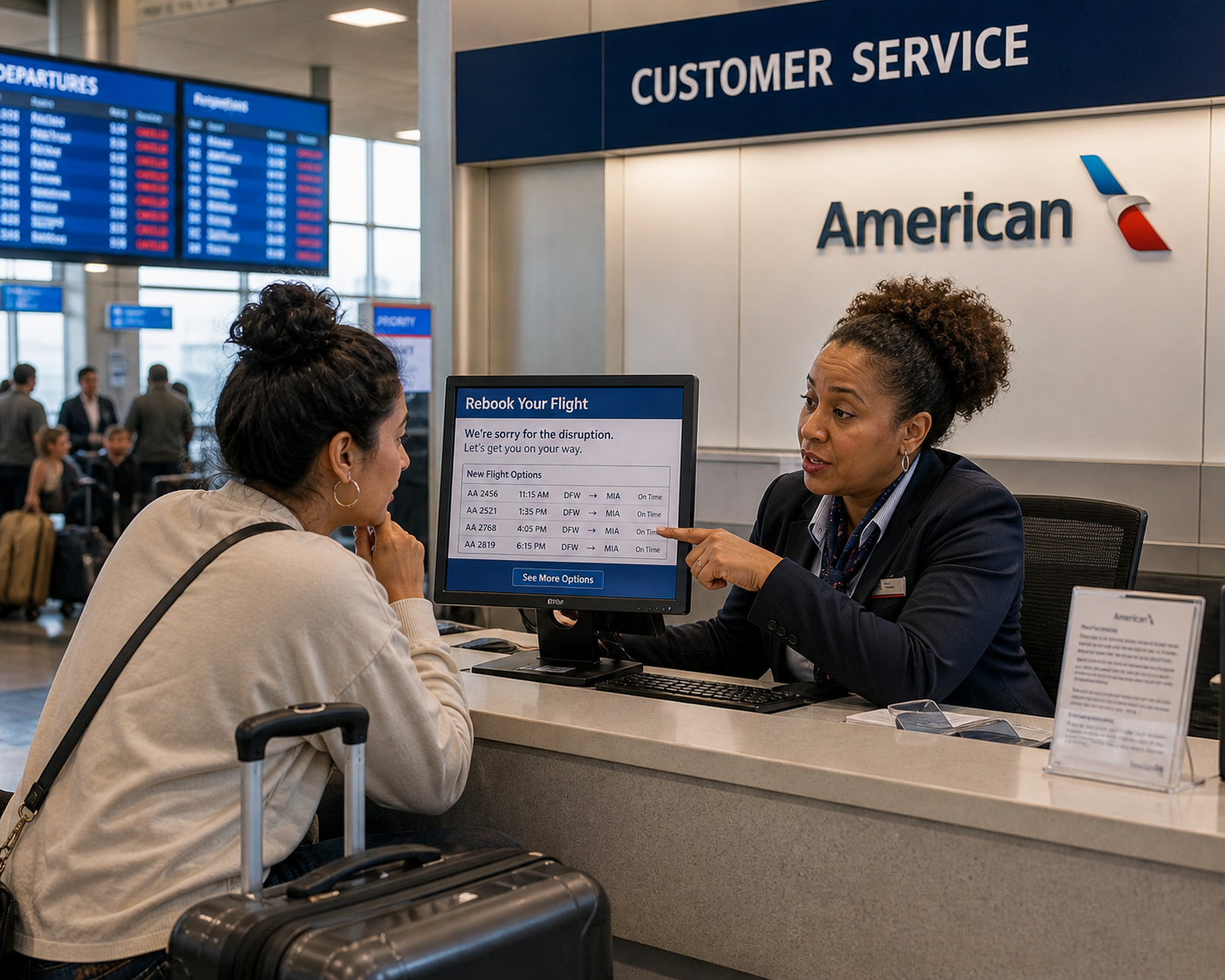
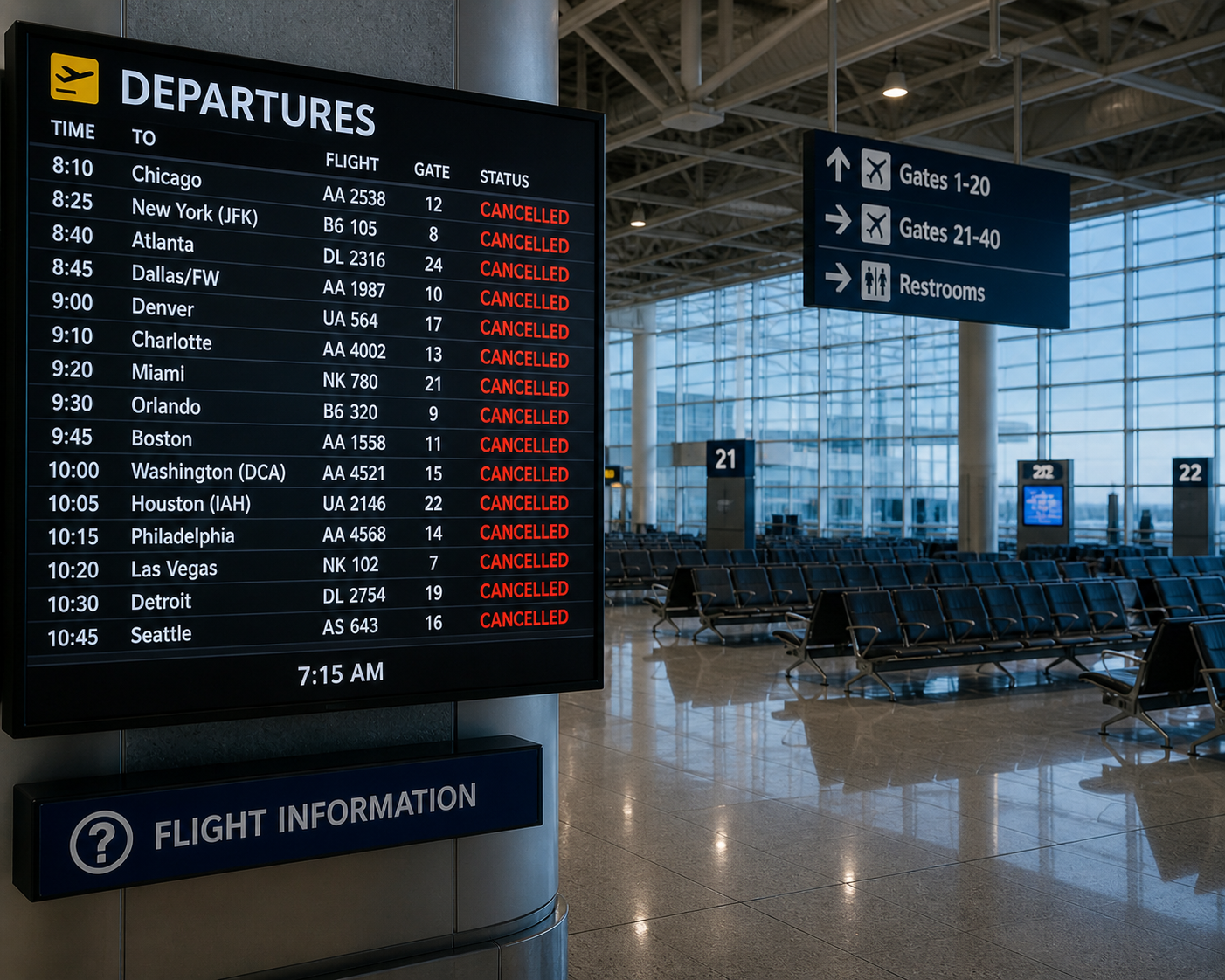
After Spirit’s shutdown, several major airlines voluntarily offered capped-price “rescue fares” to stranded passengers — a common but never guaranteed response to a competitor’s collapse.
Is There a Legal Right to Be Rebooked on Another Airline?
What Actually Happens, and Why It Isn’t Guaranteed
No U.S. law requires a competing airline to rebook you for free when your original carrier shuts down. What happens instead is usually goodwill, not obligation. When Spirit collapsed in May 2026, United, JetBlue, Southwest, American, Delta, Frontier, Avelo, and Allegiant all voluntarily offered temporary capped-price “rescue fares” for stranded Spirit passengers who could show a Spirit confirmation number — but every one of those offers expired within days to a couple of weeks, and none were required by regulation. The same pattern played out when WOW air and Bonza shut down: other carriers stepped in with short-lived discounted fares, purely as a competitive and reputational move, not a legal duty.
The practical takeaway: if your airline shuts down and you have upcoming travel, check the websites of major carriers serving your route immediately — rescue fares, when offered, tend to be time-limited and quietly discontinued once the news cycle moves on. Don’t count on one being available, and don’t wait to see if a better one appears.
Do not cancel your reservation yourself before understanding your refund options. Cancelling a ticket on your own — instead of letting the airline’s cancellation trigger your refund or chargeback rights — can eliminate protections you would otherwise be entitled to. And if the airline has confirmed it has ceased operations, don’t go to the airport: ticket counters are typically closed with no staff on-site, and any rebooking has to happen through another carrier or your travel advisor, not the shut-down airline itself.
Your Recovery Options at a Glance
| Recovery Path | What It Covers | Realistic Timeline | Best For |
|---|---|---|---|
| Automatic airline refund | Original payment method, direct bookings only | Uncertain during a bankruptcy wind-down — often delayed or never processed | Direct purchases, as a first check only |
| Credit card chargeback | Full purchase price | Filed in minutes; resolution in weeks | Any direct credit card purchase |
| Debit card dispute | Purchase price, not guaranteed | Weeks to months, no fixed protection | Debit purchases only, as a fallback |
| Travel insurance claim | Prepaid nonrefundable costs (if policy qualifies) | Days to a few weeks after filing | Trips insured before trouble was public |
| Bankruptcy claim | Uncertain — often partial or none | Months to years | Loyalty points and vouchers with no other recourse |
| Voluntary rebooking by another airline | A new ticket, not a refund | Immediate, if offered — never guaranteed | Travelers needing to fly on short notice |
What to Do, In Order, If Your Airline Just Shut Down
Step 1 — Confirm the shutdown before you act. Check the airline’s official site and a reputable news source. A single delayed or cancelled flight is not the same as a full shutdown, and the right response is different for each.
Step 2 — Don’t go to the airport if operations have fully ceased. Counters are typically closed and no agents are on-site once a wind-down is confirmed.
Step 3 — Save every piece of documentation. Confirmation emails, booking numbers, payment receipts, loyalty point balances, and voucher screenshots. You’ll need all of it for refunds, chargebacks, and any bankruptcy claim.
Step 4 — Match your purchase type to the right recovery path using the seven scenarios above — direct credit card, debit card, third-party site, travel advisor, points, vouchers, or insurance.
Step 5 — Check other airlines’ sites for rebooking help if you have near-term travel, and book quickly if a reasonable option exists — these offers, when available, don’t last.
Step 6 — File a travel insurance claim right away if you’re covered; most policies have their own claim-filing deadlines separate from any airline or bankruptcy timeline.
Step 7 — Contact Etravels Everywhere if you’d like help navigating rebooking, a chargeback, or an insurance claim — this is exactly the kind of situation a travel advisor exists for.
I recommend travel insurance with financial default coverage on every booking, without exception — not because airlines fail often, but because when they do, insurance is often the only path to getting 100% of your money back quickly instead of waiting on a bankruptcy court for years. The Spirit Airlines shutdown is a good reminder of why the timing matters: buy your coverage when you book, not after the news breaks. Every trip I plan through Etravels Everywhere includes a conversation about travel protection from day one. Use our free Travel Insurance Checker here.
The broader lesson: Travelers who book through an advisor generally have one phone call to make when something like this happens. The advisor handles the refund conversation, checks for rebooking options, and files the insurance claim. Travelers who booked independently are often left navigating hold music, expired rescue fares, and an uncertain bankruptcy process on their own. Book your future travel with Etravels Everywhere so a supplier failure is never something you have to handle alone.
Want Your Next Trip Protected Before Anything Goes Wrong?
Etravels Everywhere builds travel protection into every itinerary from the start — the right insurance, the right payment method, and a real person to call if a supplier ever fails. Book a free consultation to plan your next trip with that protection already in place.
Book My Free Consultation Now Check My Travel Insurance